A little guidance
Calendar duration: months, years and leap days
Understand why a month can be 28, 29, 30 or 31 days. Compare month-end dates, leap days and a full year using the same calculator.
Month ends and leap days in real date ranges
We compared month-end and leap-year examples with the end date excluded. Calendar duration and total days describe the same interval using different units.
| Start → end | Total days | Calendar duration |
|---|---|---|
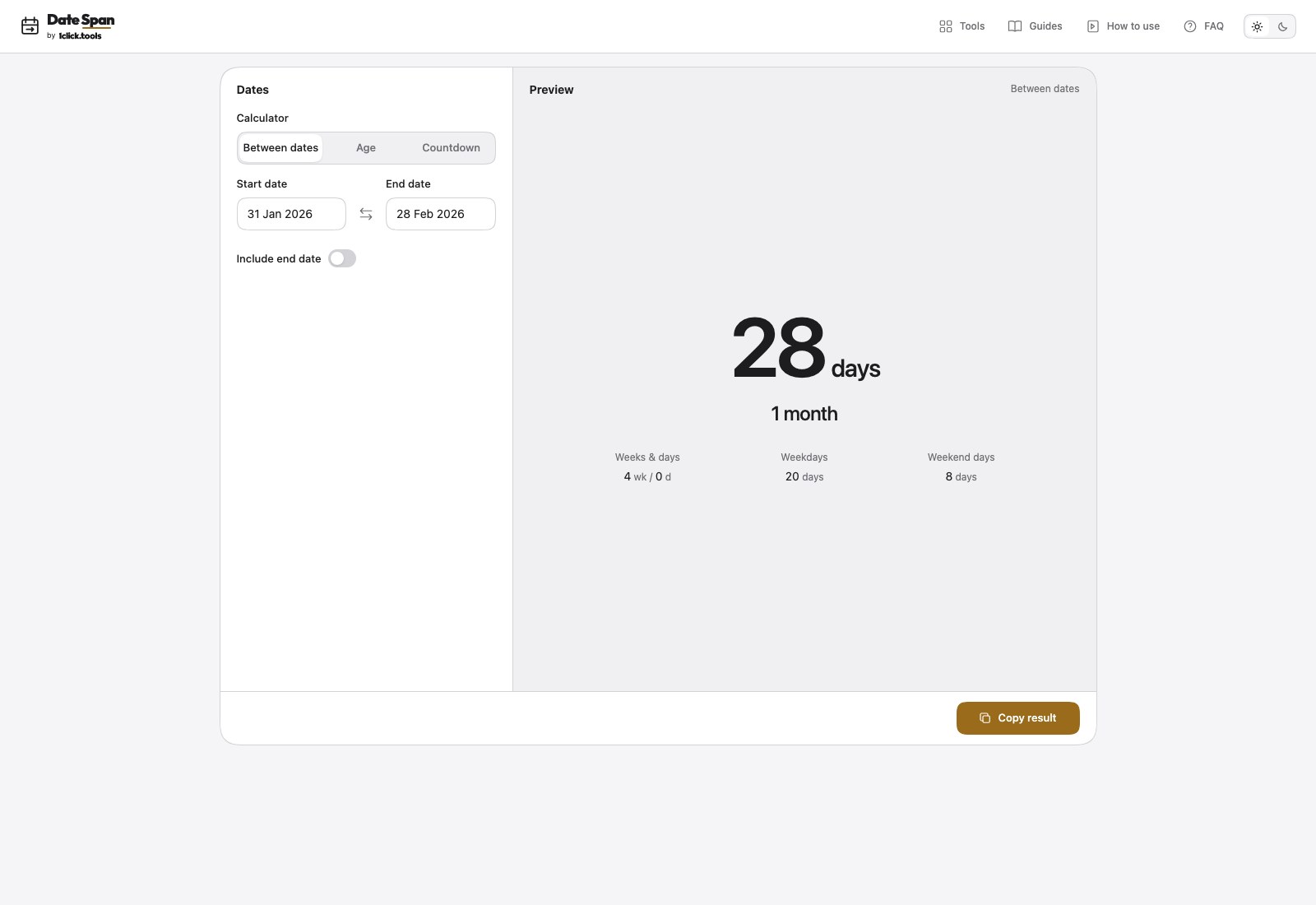
| 31 January → 28 February 2026 | 28 | 1 month |
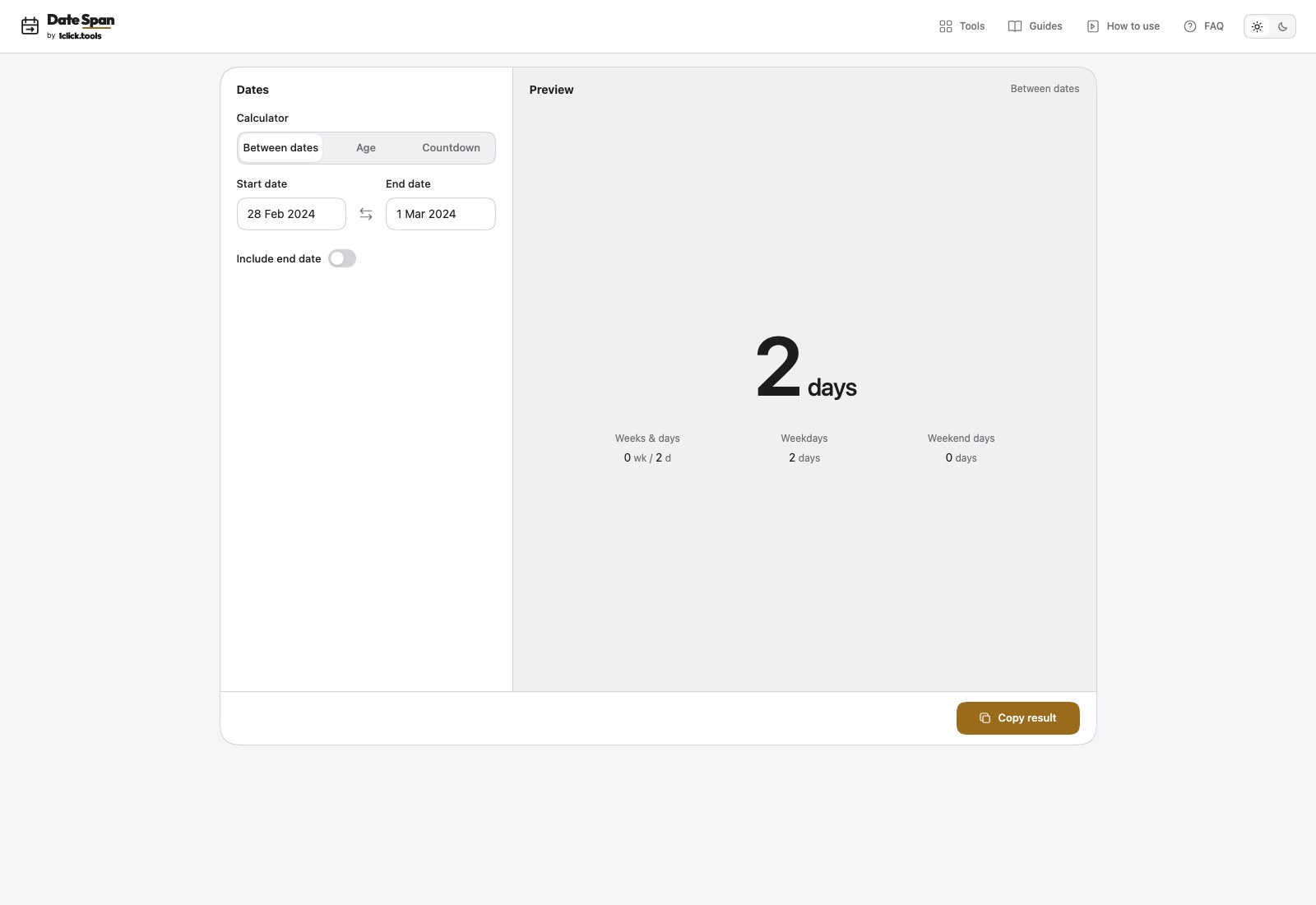
| 28 February → 1 March 2024 | 2 | 2 days |
| 29 February 2024 → 28 February 2025 | 365 | 1 year |
Gregorian calendar rules are used for every supported year. A month is not a fixed 30-day unit.
Repeat this example
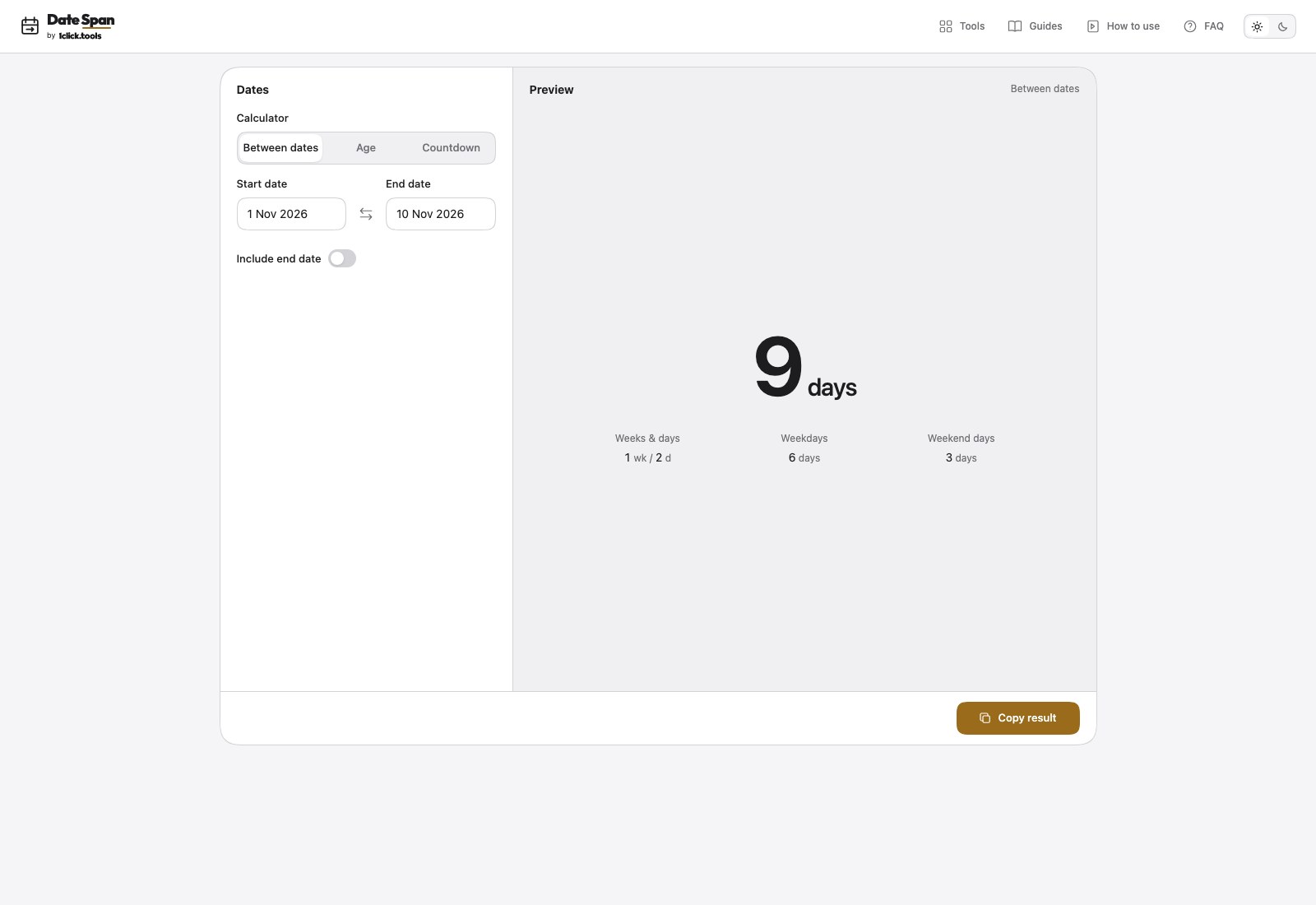
- Choose 31 January and 28 February 2026. Keep Include end date off and check 28 days and 1 month.
- Choose 28 February and 1 March 2024 to see 2 days.
- Choose 29 February 2024 and 28 February 2025 to compare 365 days with 1 calendar year.
Check the result
Calendar duration uses complete months and then remaining days. Leap-day anniversaries clamp to the last day of February in a non-leap year.
A common mistake
Dividing total days by 30 does not produce a calendar duration. Month lengths and leap years affect the result.
Try the dates in Date SpanSources and credits
Actual Date Span sessions. Screenshots show the calculator using the stated dates. Tables match its displayed results; Copy result produces text rather than a file.
Compare total days with calendar duration
Total days is a count of calendar dates. Calendar duration groups that range into whole months and remaining days, with every 12 months shown as a year. They describe the same span in different ways; a month is not treated as a fixed 30 days. Leave Include end date off for these examples.
Start with a simple days-between-dates example to check the counting rule.
Try a month-end example
Choose 31 January 2026 through 28 February 2026. The result is 28 total days and 1 month. Date Span clamps the starting day to the last valid day of the target month when that month has no 31st. From 31 January through 30 March, it shows 1 month and 30 days, because 31 March has not yet been reached.
Check a leap day
From 28 February through 1 March 2024, there are 2 days: 28 February and leap day, 29 February. The equivalent range in 2025 is only 1 day. From 29 February 2024 through 28 February 2025, the calendar breakdown is 1 year, with 365 total days.
Choose a full year
Choose 1 January as Start date and 31 December as End date, then turn on Include end date. A normal year contains 365 days, while a leap year contains 366. For an exclusive-end equivalent, use 1 January of one year through 1 January of the next year.
Use the breakdown that fits the task
Use total days for daily counts and weeks for weekly planning. Use calendar duration when you want an anniversary-style description. The tool uses Gregorian rules across its supported range, rather than historical regional calendar changes, and does not measure hours or time-zone differences.