A little guidance
How to convert Celsius to Fahrenheit (and Kelvin)
Convert temperatures between °C, °F and K with the exact formulas. Includes room temperature, oven settings, body temperature and −40°.
An oven at 180 °C, 350 °F back to Celsius, and −40°
We converted a common oven temperature to Fahrenheit, typed 350 °F in the second field, then checked the point where both scales meet.
| Typed value | Converted | Formula shown |
|---|---|---|
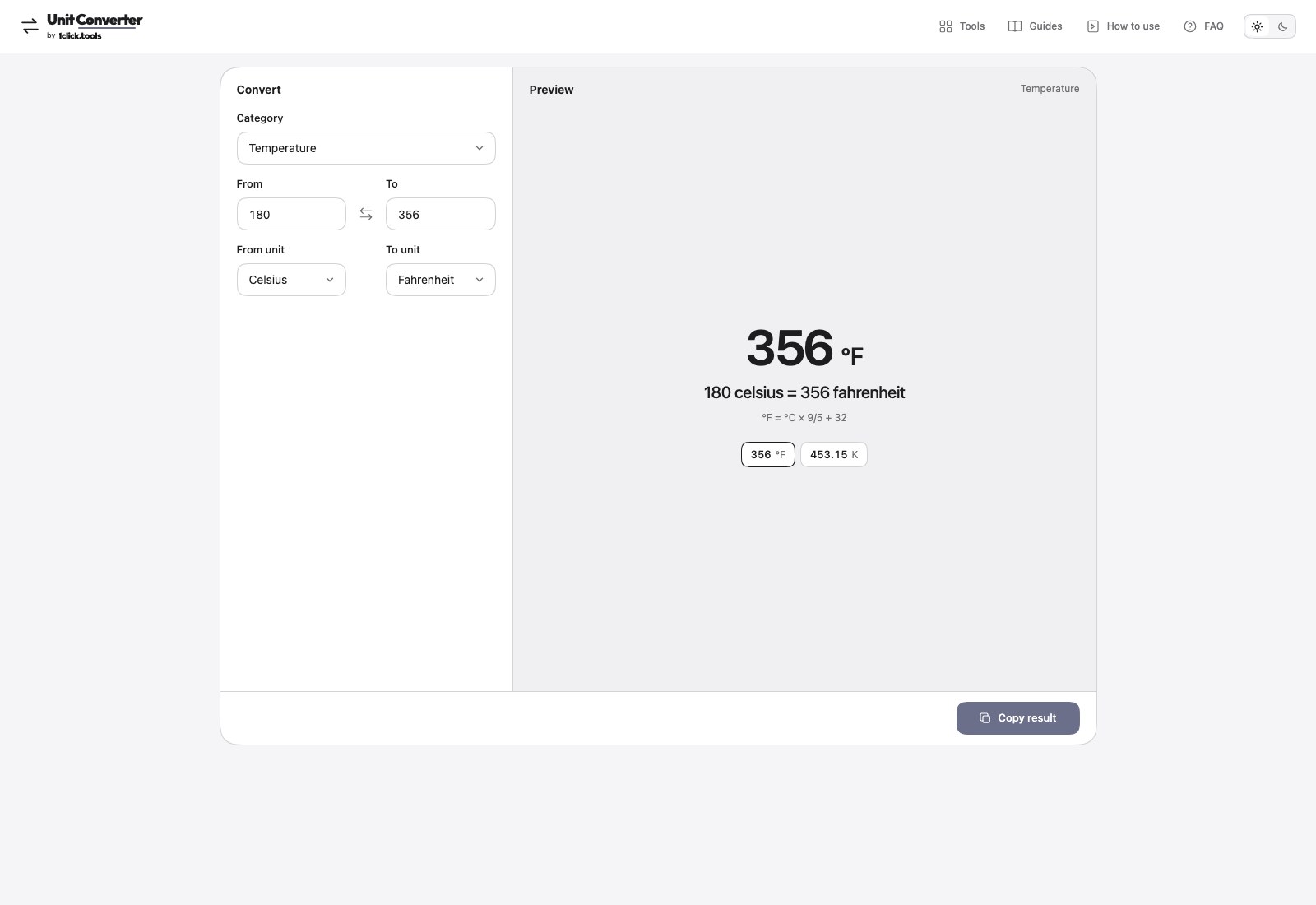
| 180 °C | 356 °F | °F = °C × 9/5 + 32 |
| 350 °F (typed in To) | 176.6666667 °C | °F = °C × 9/5 + 32 |
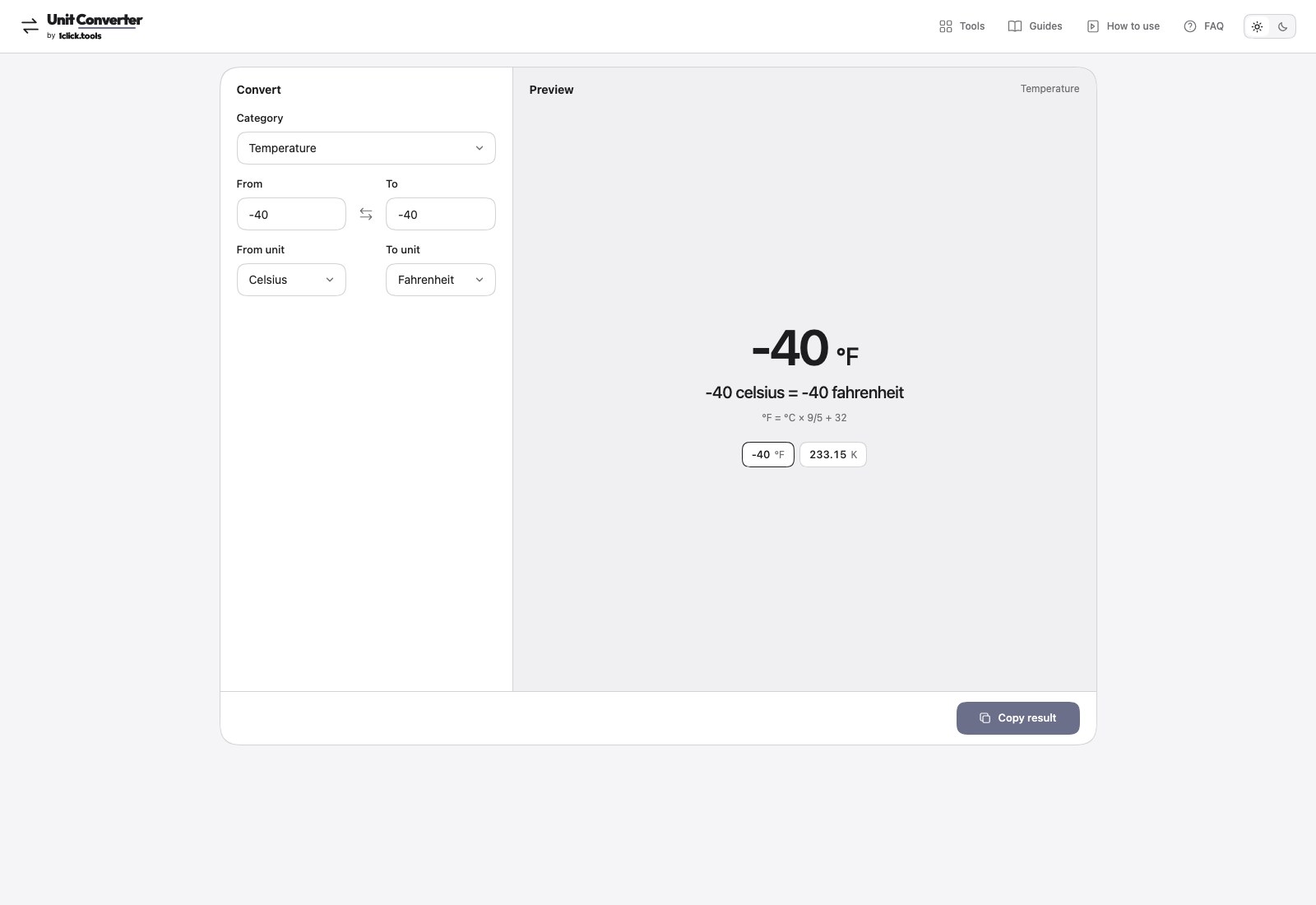
| −40 °C | −40 °F | °F = °C × 9/5 + 32 |
| 0 °C | 273.15 K | K = °C + 273.15 |
Temperatures convert with a formula, not a multiplier, because the scales have different zero points.
Repeat this example
- Select Temperature. Celsius and Fahrenheit are selected by default.
- Type 180 in From and read 356 °F.
- Type 350 in the To field to see 176.6666667 °C, then type −40 in From.
Check the result
Water boils at 100 °C, which the converter shows as 212 °F.
A common mistake
Multiplying by 1.8 without adding 32 gives 324 °F for 180 °C, which is too low.
Try 180 °C in Unit ConverterSources and credits
Actual Unit Converter sessions. Screenshots show the converter with the stated values. Tables match its displayed results; Copy result produces text rather than a file.
Open Temperature
Choose Temperature under Category in Unit Converter. It opens with Celsius in From, Fahrenheit in To and 20 in the first field, which is 68 °F. The line under the result shows the formula for the selected pair: °F = °C × 9/5 + 32.
Convert an oven setting
Type 180 in From to get 356 °F. Recipes usually round this to 350 °F. In the other direction, type 350 in the Fahrenheit field to see 176.6666667 °C, which is why 175 or 180 °C appears in metric recipes.
Converting the rest of the recipe? See cups to ml and tablespoons.
Why temperature is not a simple multiplier
Celsius and Fahrenheit have different zero points as well as different degree sizes. That is why there is no single ratio between them. For a quick estimate, double the Celsius value and add 30: 20 °C becomes 70 °F, close to the exact 68 °F.
Use Kelvin for science
Choose Kelvin in either field. Kelvin uses the same degree size as Celsius but starts at absolute zero, so 0 °C is 273.15 K. Typing a value below absolute zero, such as −300 °C, shows a note that the temperature is not physically possible.
Check with known values
Water freezes at 0 °C (32 °F) and boils at 100 °C (212 °F) at sea level. Normal body temperature is often given as 37 °C, which is 98.6 °F. At −40 the two scales meet: −40 °C is exactly −40 °F.